APOD: The Mystery of the Fading Star

Via: The Mystery of the Fading Star
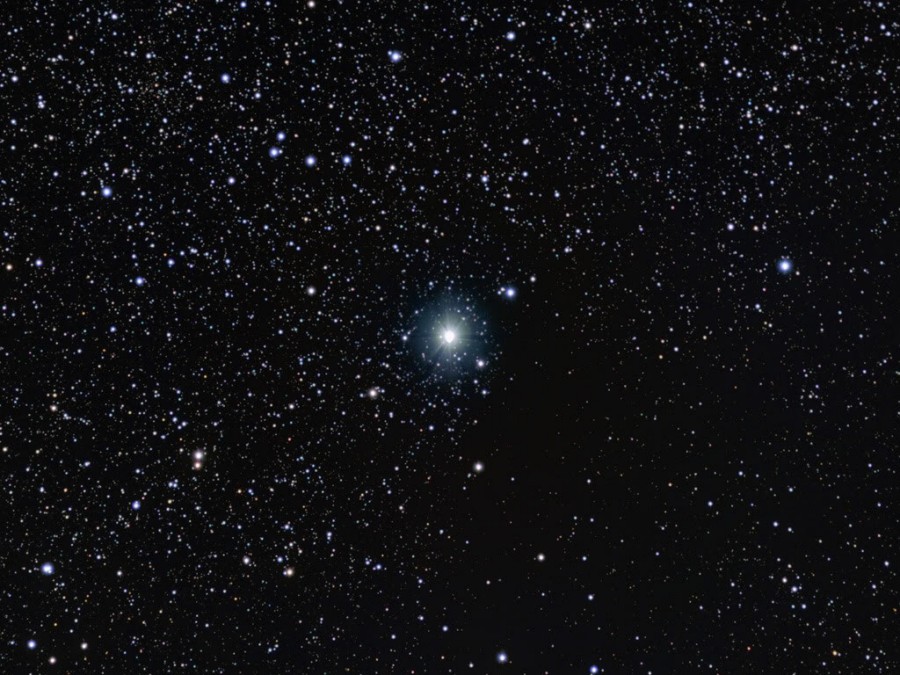
Explanation: Every 27 years Epsilon Aurigae fades, remaining dim for roughly two years before growing bright again. Since the 19th century, astronomers have studied the mystery star, eventually arguing that Epsilon Aur, centered in this telescopic skyview, was actually undergoing a long eclipse by a dark companion object. But the nature of the companion and even the state of bright star itself could not be pinned down by observations. Continuing to collect evidence, Citizen Sky, a team of professional and amateur astronomers, is studying the current eclipse of Epsilon Aur, reporting that it began in August 2009 and by late December had reached its deepest point. Epsilon Aur is now expected to remain dim for all of 2010, before rapidly regaining normal brightness in 2011. Meanwhile, recent infrared data from the Spitzer Space Telescope supports a model for the enigmatic system that identifies Epsilon Aur as a large but lower mass star near the end of its life, periodically eclipsed by a single star embedded in a dusty disk. The disk is estimated to have a radius of about 4 AU, or 4 times the Earth-Sun distance, and to be about 0.5 AU thick.
APOD: Planetary Systems Now Forming in Orion

Je commence en beaute avec ce premier post.

Via: Planetary Systems Now Forming in Orion

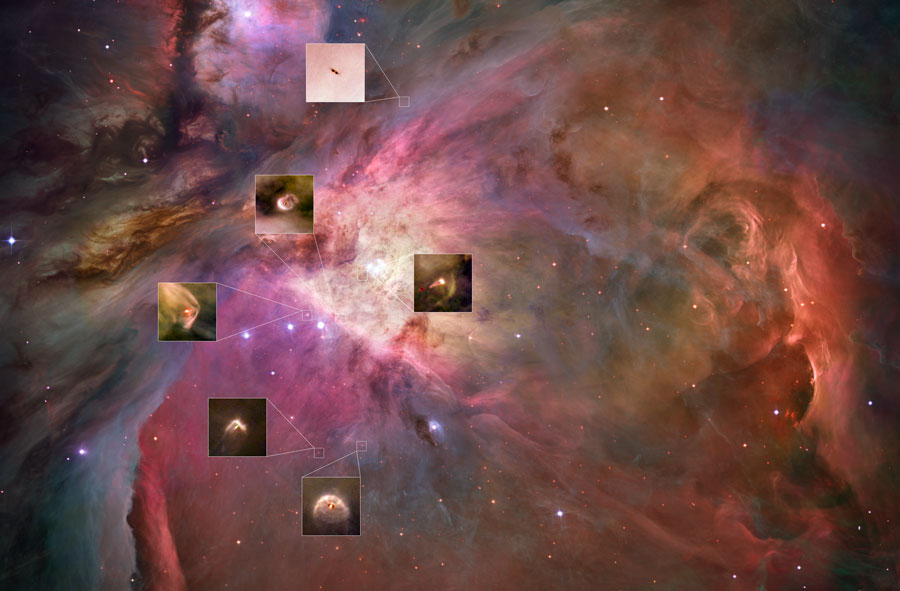
Explanation: How do planets form? To help find out, the Hubble Space Telescope was tasked to take a detailed look at one of the more interesting of all astronomical nebulae, the Great Nebula in Orion. The Orion nebula, visible with the unaided eye near the belt in the constellation of Orion, is an immense nearby starbirth region and probably the most famous of all astronomical nebulas. Insets to the above mosaic show numerous proplyds, many of which are stellar nurseries likely harboring planetary systems in formation. Some proplyds glow as close disks surrounding bright stars light up, while other proplyds contain disks further from their host star, contain cooler dust, and hence appear as dark silhouettes against brighter gas. Studying this dust, in particular, is giving insight for how planets are forming. Many proplyd images also show arcs that are shock waves – fronts where fast moving material encounters slow moving gas. The Orion Nebula lies about 1,500 light years distant and is located in the same spiral arm of our Galaxy as our Sun.