Rover 1A Hops on Asteroid Ryugu

Google+ reshared post

Rover 1A Hops on Asteroid Ryugu
Image Credit & Copyright: ISAS, +JAXA | 宇宙航空研究開発機構, Hayabusa2 Mission
https://apod.nasa.gov/apod/ap180924.html

Two small robots have begun hopping around the surface of asteroid Ryugu. The rovers, each the size of a small frying pan, move around the low gravity of kilometer-sized 162173 Ryugu by hopping, staying aloft for about 15 minutes and typically landing again several meters away. On Saturday, Rover 1A returned an early picture of its new home world, on the left, during one of its first hops. On Friday, lander MINERVA-II-1 detached from its mothership Hayabusa2, dropped Rovers 1A and 1B, and then landed on Ryugu. Studying Ryugu could tell humanity not only about Ryugu’s surface and interior, but about what materials were available in the early Solar System for the development of life. Two more hopping rovers are planned for release, and Hayabusa2 itself is scheduled to collect a surface sample from Ryugu and return it to Earth for detailed analysis before 2021.

Importé de Google+

Asteroid Ryugu from Hayabusa2

Google+ reshared post

Asteroid Ryugu from Hayabusa2
Image Credit & Copyright: ISAS, +JAXA | 宇宙航空研究開発機構
https://apod.nasa.gov/apod/ap180822.html

This big space diamond has an estimated value of over 80 billion dollars. It’s only diamond in shape, though — asteroid 162173 Ryugu is thought to be composed of mostly nickel and iron. Asteroids like Ryugu are interesting for several reasons, perhaps foremost because they are near the Earth and might, one day in the far future, pose an impact threat. In the nearer term, Ryugu is interesting because it may be possible to send future spacecraft there to mine it, thus providing humanity with a new source of valuable metals. Scientifically, Ryugu is interesting because it carries information about how our Solar System formed billions of years ago, and why its orbit takes it so close to Earth. Japan’s robotic spacecraft Hayabusa2 just arrived at this one-kilometer wide asteroid in late June. The featured image shows surface structures unknown before spacecraft Hayabusa2’s arrival, including rock fields and craters. Within the next three months, Hayabusa2 is scheduled to unleash several probes, some that will land on Ryugu and hop around, while Hayabusa2 itself will mine just a little bit of the asteroid for return to Earth.

Importé de Google+

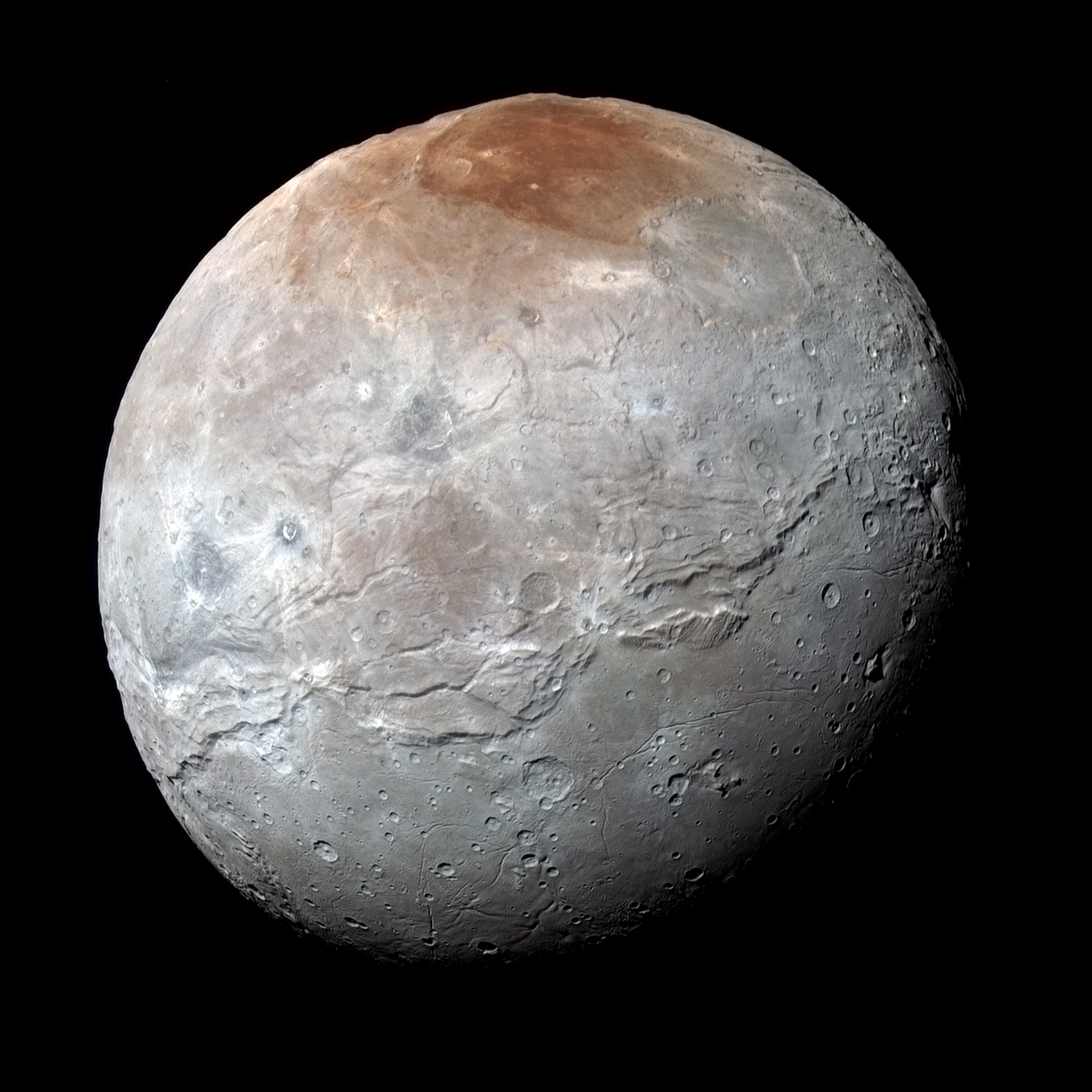
Charon: Moon of Pluto

Google+ reshared post

Charon: Moon of Pluto
Image Credit: +NASA, Johns Hopkins Univ./APL, Southwest Research Institute, U.S. Naval Observatory
https://apod.nasa.gov/apod/ap180706.html

A darkened and mysterious north polar region known to some as Mordor Macula caps this premier high-resolution view. The portrait of Charon, Pluto’s largest moon, was captured by New Horizons near the spacecraft’s closest approach on July 14, 2015. The combined blue, red, and infrared data was processed to enhance colors and follow variations in Charon’s surface properties with a resolution of about 2.9 kilometers (1.8 miles). A stunning image of Charon’s Pluto-facing hemisphere, it also features a clear view of an apparently moon-girdling belt of fractures and canyons that seems to separate smooth southern plains from varied northern terrain. Charon is 1,214 kilometers (754 miles) across. That’s about 1/10th the size of planet Earth but a whopping 1/2 the diameter of Pluto itself, and makes it the largest satellite relative to its parent body in the Solar System. Still, the moon appears as a small bump at about the 1 o’clock position on Pluto’s disk in the grainy, negative,telescopic picture inset at upper left. That view was used by James Christy and Robert Harrington at the U.S. Naval Observatory in Flagstaff to discover Charon 40 years ago in June of 1978.


Importé de Google+