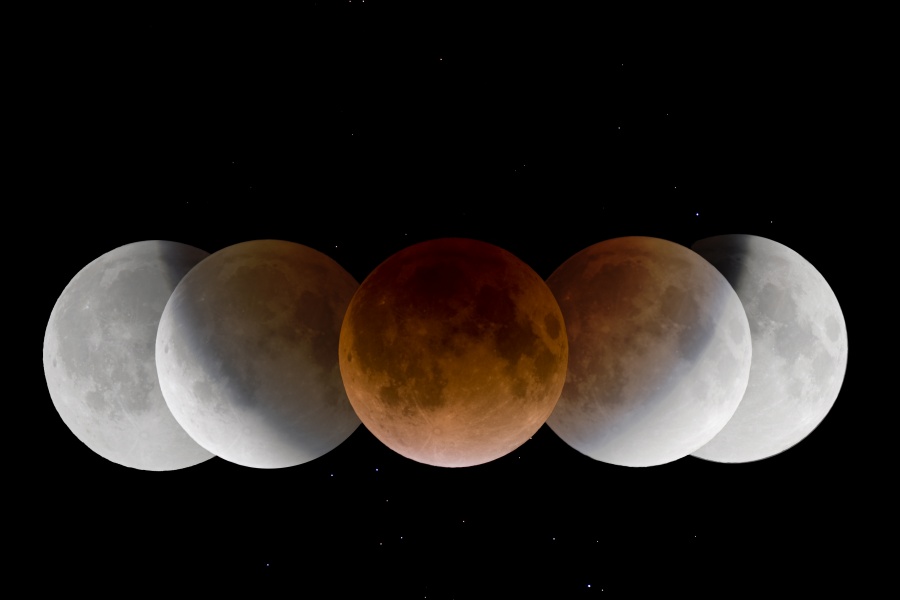
APOD: The Umbra of Earth
Reply
skyandtelescope.com: Asteroid To Buzz Earth Monday, June 27th
Via: slashdot.org: Asteroid To Pass Near Earth On Monday
Asteroid 2011 MD, a chunk of rock estimated to be 25 to 55 feet (8 to 18 m) across, is expected to pass less than 8,000 miles above Earth’s surface around 1 p.m. EDT (17:00 UT) on Monday, June 27th. The actual event will be observable only from South Africa and parts of Antarctica, but the approach will be visible across Australia, New Zealand, southern and eastern Asia, and the western Pacific.

io9.com: Earth may soon have a second sun
Via: Earth may soon have a second sun
The star is located in the Orion constellation, about 640 light-years away from Earth. It’s one of the brightest and biggest stars in our galactic neighborhood – if you dropped it in our Solar System, it would extend all the way out to Jupiter, leaving Earth completely engulfed. In stellar terms, it’s predicted to explode in the very near future. Of course, the conversion from stellar to human terms is pretty extreme, as Betelgeuse is predicted to explode anytime in the next million years.
J’aimerais bien voir ca de mon vivant, a condition qu’on ne soit pas directement alignes sur un des poles 😉 Mais disons que les chances sont assez minces avec l’horizon de un million d’annees 🙁
slashdot.org: NASA’s Kepler Spots Its First Rocky Exoplanet
“NASA today said its star-gazing satellite Kepler has identified its first rocky planet orbiting a sun similar to our own — 560 light years from our solar system. While not in an area of space considered habitable, the rocky planet known as Kepler-10b is never-the-less significant because it showcases the ability of Kepler to find and track such small exoplanetary movements.
slashdot.org: The Moon Has a Fluid Outer Core
The new research confirms the existence of a solid inner core and liquid outer layer, similar to Earth’s. Unlike Earth, the moon also has a partly melted, mushy layer over that.
Seismic Detection of the Lunar Core
Abstract:
Despite recent insight regarding the history and current state of the Moon from satellite sensing and analyses of limited Apollo-era seismic data, deficiencies remain in our understanding of the deep lunar interior. We reanalyzed Apollo lunar seismograms using array processing methods to search for the presence of reflected and converted seismic energy from the core. Our results suggest the presence of a solid inner and fluid outer core, overlain by a partially molten boundary layer. The relative sizes of the inner and outer core suggest that the core is ~60% liquid by volume. Based on phase diagrams of iron alloys and the presence of partial melt, the core likely contains less than 6 weight % of lighter alloying components, which is consistent with a volatile-depleted interior.
Cosmic Variance : Farewell, Pioneer Anomaly?
Five years have passed. Using the telemetry data, the two scientists created an extremely elaborate “finite element” 3-D computer model of each Pioneer spacecraft, in which the thermal properties of 100,000 positions on their surfaces are independently tracked for the duration of the 30-year mission.
But according to Toth, “You can take it to the bank that whatever remains of the anomaly after accounting for that thermal acceleration, it will at most be much less than the canonical value of 8.74 x 10⁻¹⁰ m/s2, and then, mind you, all those wonderful numerical coincidences people talk about are destroyed.”
neuraldump.com : How Many Asteroids Do We Know About?
J’ai trouve cette version du video avec une trame sonore differente (who cares 😉 ) et la possibilite de le regarde en HD 1080p.
Plusieurs choses interessantes. Dans un premier temps, l’explosion du nombre d’asteroides decouverts dans les dernieres annees. Ensuite, le nombre d’asteroides (rouges dans le video) qui croisent l’orbite terrestre. Finalement, avec d’aussi grands nombres, rien de mieux qu’une representation graphique pour realiser combien il peut y en avoir! Et dire que le premier a ete decouvert seulement en 1801 et que seulement 15 avaient ete decouverts a la fin de 1851.
APAD: Comet McNaught Becoming Visible to the Unaided Eye
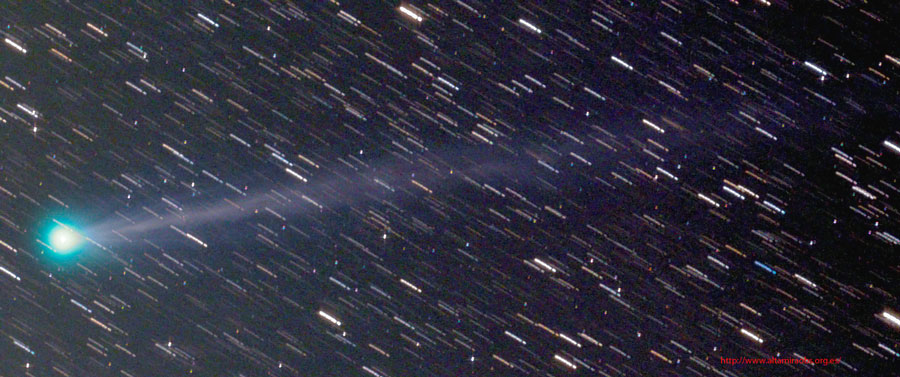
Explanation: A new comet is brightening and is now expected to become visible to the unaided eye later this month. C/2009 R1 (McNaught) is already showing an impressive tail and is currently visible through binoculars. The above image, taken yesterday from the Altamira Observatory in the Canary Islands and spanning about five degrees, shows an impressive green coma and a long ion tail in front of distant star trails. Although predicting the brightness of comets is notoriously difficult, current estimates place Comet McNaught as becoming visible to unaided northern hemisphere observers in late June, before sunrise, and in early July, after sunset. Discovered by Robert McNaught last year, the sun-orbiting iceberg will pass the Earth next week and will continue to melt and shed debris as it closes in on the Sun until early July. After reaching about half of the Earth-Sun distance from the Sun, the comet should fade rapidly as it then heads out of the inner Solar System.