Importé de Google+
Bear and Goose at the End of Everything
Reply
Importé de Google+
Google+ reshared post
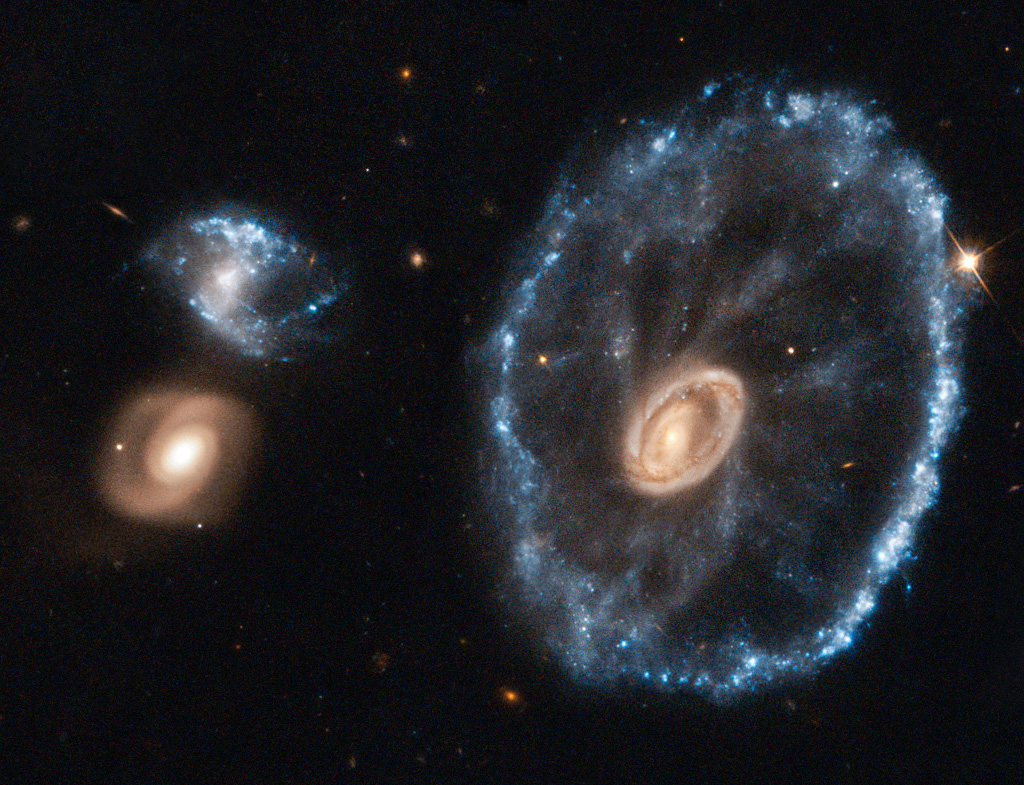
Cartwheel of Fortune
Image Credit: +European Space Agency, ESA, +NASA
https://apod.nasa.gov/apod/ap180125.htmlBy chance, a collision of two galaxies has created a surprisingly recognizable shape on a cosmic scale, The Cartwheel Galaxy. The Cartwheel is part of a group of galaxies about 500 million light years away in the constellation Sculptor. Two smaller galaxies in the group are visible on the right. The Cartwheel Galaxy’s rim is an immense ring-like structure 150,000 light years in diameter composed of newly formed, extremely bright, massive stars. When galaxies collide they pass through each other, their individual stars rarely coming into contact. Still, the galaxies’ gravitational fields are seriously distorted by the collision. In fact, the ring-like shape is the result of the gravitational disruption caused by a small intruder galaxy passing through a large one, compressing the interstellar gas and dust and causing a a star formation wave to move out from the impact point like a ripple across the surface of a pond. In this case the large galaxy may have originally been a spiral, not unlike our own Milky Way, transformed into the wheel shape by the collision. But … what happened to the small intruder galaxy?
Importé de Google+
Importé de Google+
Google+ reshared post
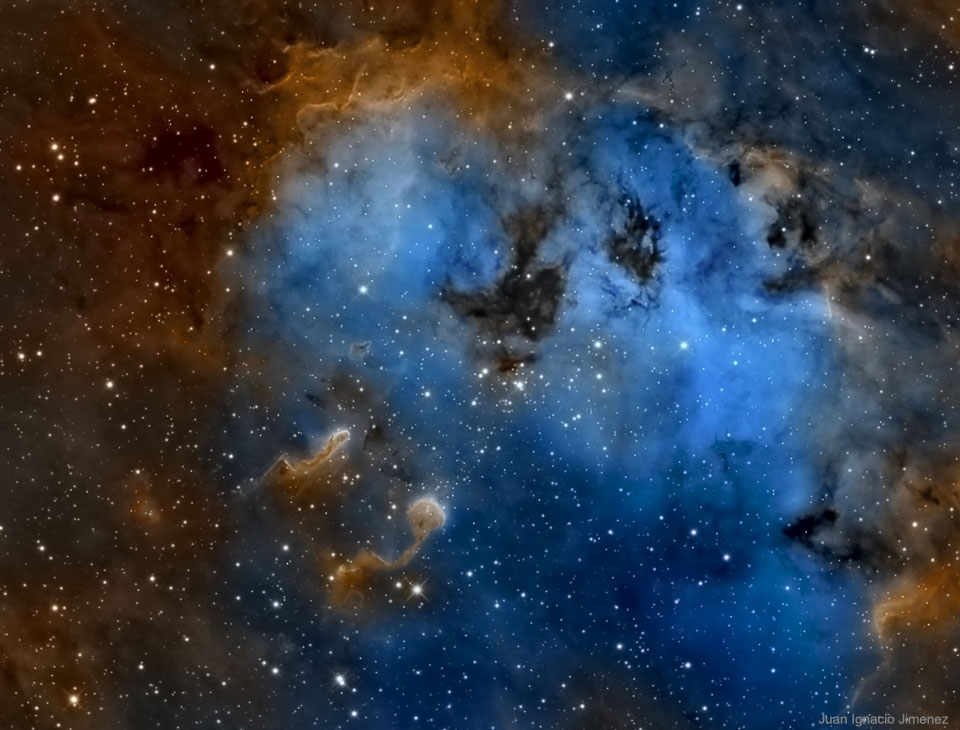
The Tadpoles of IC 410
Image Credit: Juan Ignacio Jimenez
https://apod.nasa.gov/apod/ap180124.htmlThis telescopic close-up shows off the otherwise faint emission nebula IC 410. It also features two remarkable inhabitants of the cosmic pond of gas and dust below and left of center, the tadpoles of IC 410. Partly obscured by foreground dust, the nebula itself surrounds NGC 1893, a young galactic cluster of stars. Formed in the interstellar cloud a mere 4 million years ago, the intensely hot, bright cluster stars energize the glowing gas. Composed of denser cooler gas and dust, the tadpoles are around 10 light-years long and are likely sites of ongoing star formation. Sculpted by winds and radiation from the cluster stars, their heads are outlined by bright ridges of ionized gas while their tails trail away from the cluster’s central region. IC 410 lies some 10,000 light-years away, toward the nebula-rich constellation Auriga.
Importé de Google+
Importé de Google+
Google+ reshared post
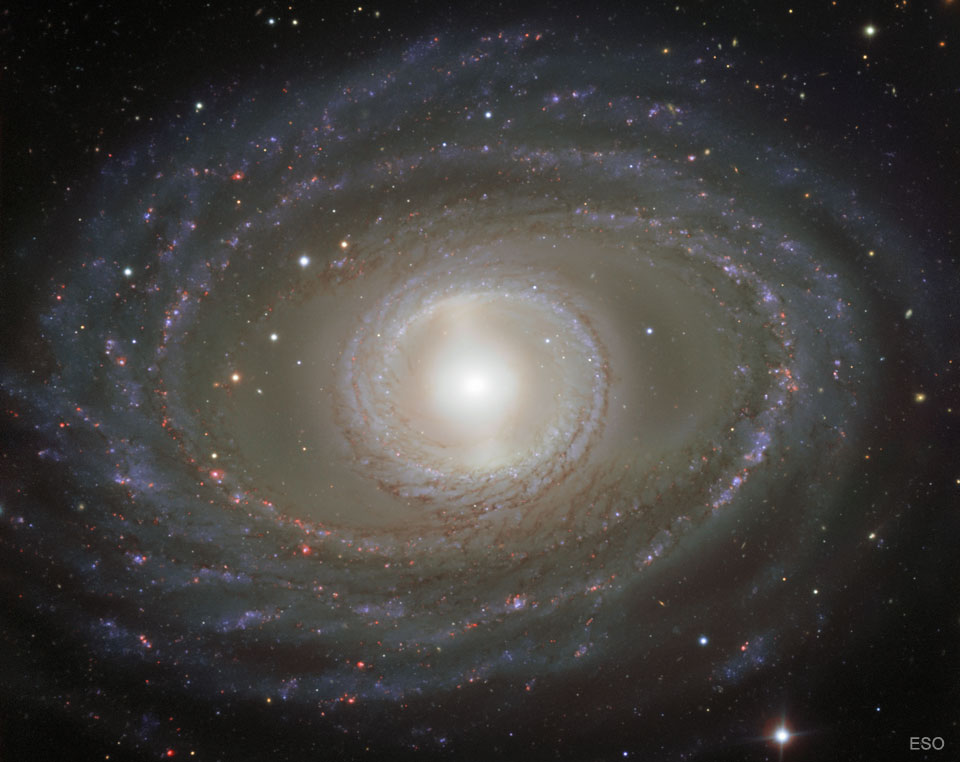
Ribbons and Pearls of Spiral Galaxy NGC 1398
Image Credit: European Southern Observatory
https://apod.nasa.gov/apod/ap180123.htmlWhy do some spiral galaxies have a ring around the center? Spiral galaxy NGC 1398 not only has a ring of pearly stars, gas and dust around its center, but a bar of stars and gas across its center, and spiral arms that appear like ribbons farther out. The featured image was taken with ESO’s Very Large Telescope at the Paranal Observatory in Chile and resolves this grand spiral in impressive detail. NGC 1398 lies about 65 million light years distant, meaning the light we see today left this galaxy when dinosaurs were disappearing from the Earth. The photogenic galaxy is visible with a small telescope toward the constellation of the Furnace (Fornax). The ring near the center is likely an expanding density wave of star formation, caused either by a gravitational encounter with another galaxy, or by the galaxy’s own gravitational asymmetries.
Importé de Google+
Tres impressionnant. En general, on voit des arcs de cercle, mais la projection pour faire le pano de 360 degres rend la chose encore plus sexy.
Google+ reshared post
360-degree, 3-hour star trail panorama
http://earthsky.org/todays-image/360-degree-3-hour-startrail-panorama

Importé de Google+
Bad Astronomy: Exoplanet news part 3: There may be hundreds of *billions* of planets in our galaxy!
The new result comes from what’s called microlensing.
This kind of event takes an extraordinarily precise alignment, so they’re extremely rare. To compensate, you need to look at a lot of stars. So astronomers did: a survey using two telescopes covered several million stars every night, looking for the tell-tale bump(s). Over the course of six years, they found three — yes, only three — planets orbiting other stars acting like wee distant lenses. But that number is actually pretty good: when combined with previous surveys, and also taking into account how many lenses they didn’t see (which is important, statistically), they can extrapolate with some confidence about the numbers and types of exoplanets out there.
nasa.gov: Comet Lovejoy Plunges into the Sun and Survives
Via: slashdot.org: Comet Lovejoy Plunges Into the Sun and Survives
“It’s absolutely astounding,” says Karl Battams of the Naval Research Lab in Washington DC. “I did not think the comet’s icy core was big enough to survive plunging through the several million degree solar corona for close to an hour, but Comet Lovejoy is still with us.”
The most dramatic footage so far comes from SDO, which saw the comet go in (movie) and then come back out again (movie).
Comet Lovejoy was discovered on Dec. 2, 2011, by amateur astronomer Terry Lovejoy of Australia. Researchers quickly realized that the new find was a member of the Kreutz family of sungrazing comets. Named after the German astronomer Heinrich Kreutz, who first studied them, Kreutz sungrazers are fragments of a single giant comet that broke apart back in the 12th century (probably the Great Comet of 1106). Kreutz sungrazers are typically small (~10 meters wide) and numerous. The Solar and Heliospheric Observatory sees one falling into the sun every few days.