Google+ reshared post
Kepler solves star explosion mystery http://bit.ly/2utjCVK
An astronomer said, “When I first saw the Kepler data, my jaw dropped. I said, ‘Oh wow!’”
Importé de Google+
Google+ reshared post
Kepler solves star explosion mystery http://bit.ly/2utjCVK
An astronomer said, “When I first saw the Kepler data, my jaw dropped. I said, ‘Oh wow!’”
Importé de Google+
Importé de Google+
Google+ reshared post
Scientists have noticed that Jupiter’s Great Red Spot has been getting smaller over time. New evidence says the storm is getting taller – and more orange – as it shrinks. http://bit.ly/2GMIDxL
Importé de Google+
Google+ reshared post
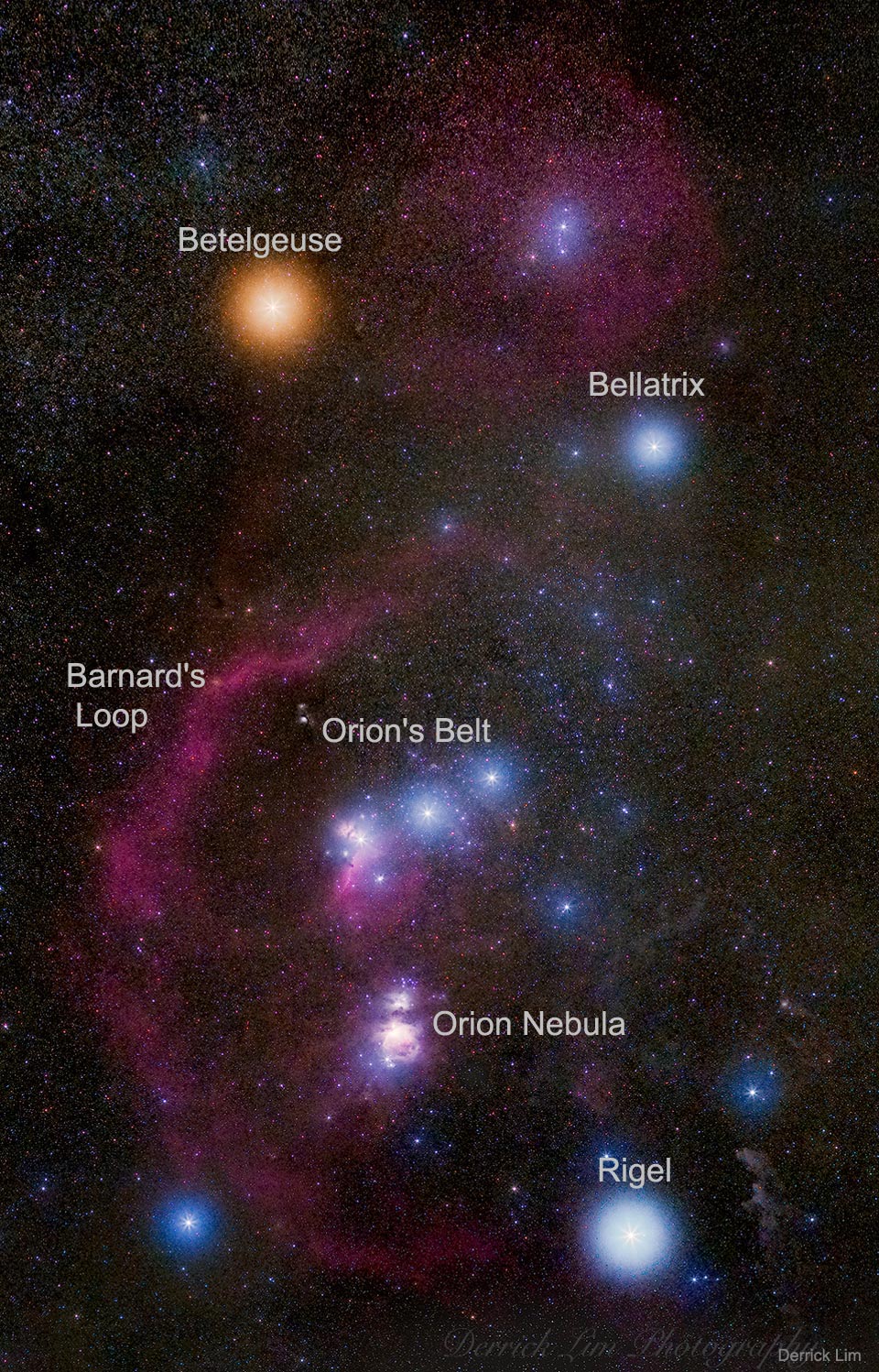
Camera Orion
Image Credit & Copyright: Derrick Lim
https://apod.nasa.gov/apod/ap180321.htmlDo you recognize this constellation? Although it is one of the most recognizable star groupings on the sky, Orion’s icons don’t look quite as colorful to the eye as they do to a camera. In this 20-image digitally-composed mosaic, cool red giant Betelgeuse takes on a strong orange tint as the brightest star at the upper left. Orion’s hot blue stars are numerous, with supergiant Rigel balancing Betelgeuse at the lower right, and Bellatrix at the upper right Lined up in Orion’s belt are three stars all about 1,500 light-years away, born from the constellation’s well-studied interstellar clouds. Below Orion’s belt a reddish and fuzzy patch that might also look familiar — the stellar nursery known as Orion’s Nebula. Finally, just barely visible to the unaided eye but quite striking here by camera is Barnard’s Loop — a huge gaseous emission nebula surrounding Orion’s Belt and Nebula discovered over 100 years ago by the pioneering Orion photographer E. E. Barnard.
Importé de Google+
Importé de Google+
Importé de Google+
Importé de Google+
Google+ reshared post
1st possible exoplanets in another galaxy
http://bit.ly/2skYBf1“We are able to study them, unveil their presence and even have an idea of their masses. This is very cool science.”
Importé de Google+
Google+ reshared post
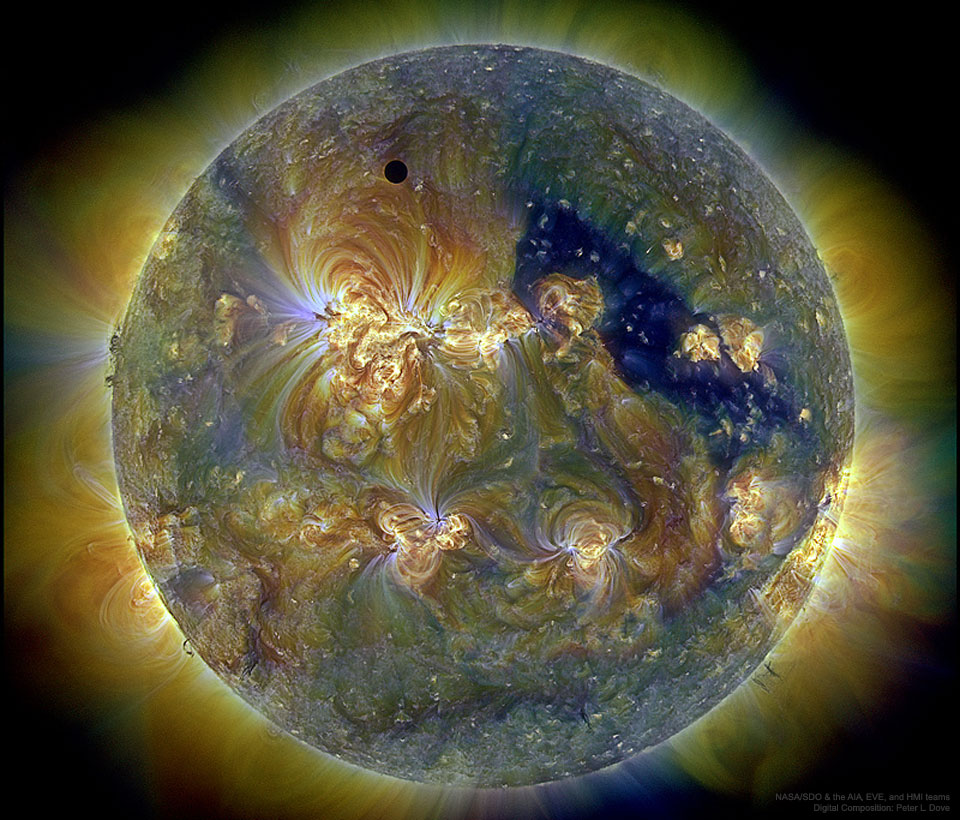
Venus and the Triply Ultraviolet Sun
Image Credit: +NASA/SDO & the AIA, EVE, and HMI teams; Digital Composition: Peter L. Dove
https://apod.nasa.gov/apod/ap180204.htmlAn unusual type of solar eclipse occurred in 2012. Usually it is the Earth’s Moon that eclipses the Sun. That year, most unusually, the planet Venus took a turn. Like a solar eclipse by the Moon, the phase of Venus became a continually thinner crescent as Venus became increasingly better aligned with the Sun. Eventually the alignment became perfect and the phase of Venus dropped to zero. The dark spot of Venus crossed our parent star. The situation could technically be labeled a Venusian annular eclipse with an extraordinarily large ring of fire. Pictured here during the occultation, the Sun was imaged in three colors of ultraviolet light by the Earth-orbiting Solar Dynamics Observatory, with the dark region toward the right corresponding to a coronal hole. Hours later, as Venus continued in its orbit, a slight crescent phase appeared again. The next Venusian transit across the Sun will occur in 2117.
Importé de Google+
Importé de Google+