Google+ reshared post
Here’s Why Saturn’s Inner Moons Are Shaped Like Ravioli and Potatoes
Here’s Why Saturn’s Inner Moons Are Shaped Like Ravioli and Potatoes
Importé de Google+
Google+ reshared post
Here’s Why Saturn’s Inner Moons Are Shaped Like Ravioli and Potatoes
Here’s Why Saturn’s Inner Moons Are Shaped Like Ravioli and Potatoes
Importé de Google+
Importé de Google+
Importé de Google+
Google+ reshared post
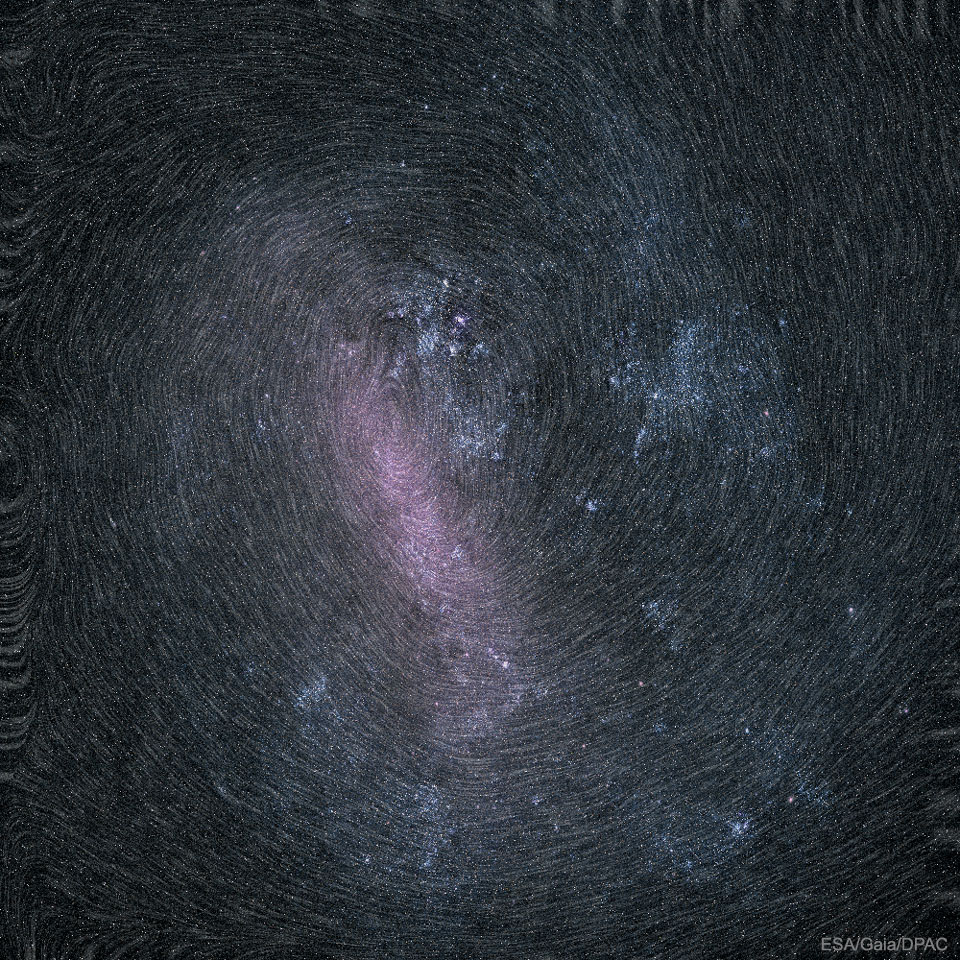
Rotation of the Large Magellanic Cloud
Image Credit & Licence: +European Space Agency, ESA , Gaia, DPAC
https://apod.nasa.gov/apod/ap180516.htmlThis image is not blurry. It shows in clear detail that the largest satellite galaxy to our Milky Way, the Large Cloud of Magellan (LMC), rotates. First determined with Hubble, the rotation of the LMC is presented here with fine data from the Sun-orbiting Gaia satellite. Gaia measures the positions of stars so accurately that subsequent measurements can reveal slight proper motions of stars not previously detectable. The featured image shows, effectively, exaggerated star trails for millions of faint LMC stars. Inspection of the image also shows the center of the clockwise rotation: near the top of the LMC’s central bar. The LMC, prominent in southern skies, is a small spiral galaxy that has been distorted by encounters with the greater Milky Way Galaxy and the lesser Small Magellanic Cloud (SMC).
Importé de Google+
Google+ reshared post
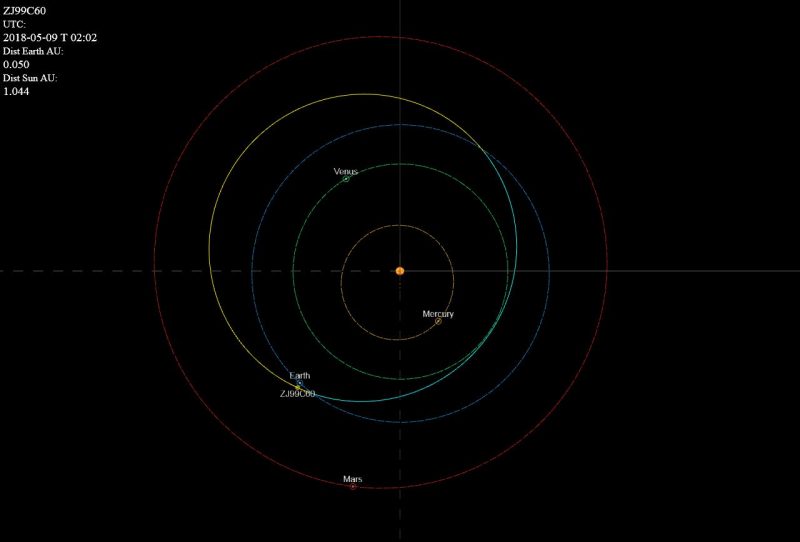
‘Lost’ asteroid 2010 WC9 to pass closely tomorrow
http://bit.ly/2wH8VQsIt’s one of the closest approaches ever observed of an asteroid of this size. Click in for information about tonight’s viewing online.
Importé de Google+
Google+ reshared post
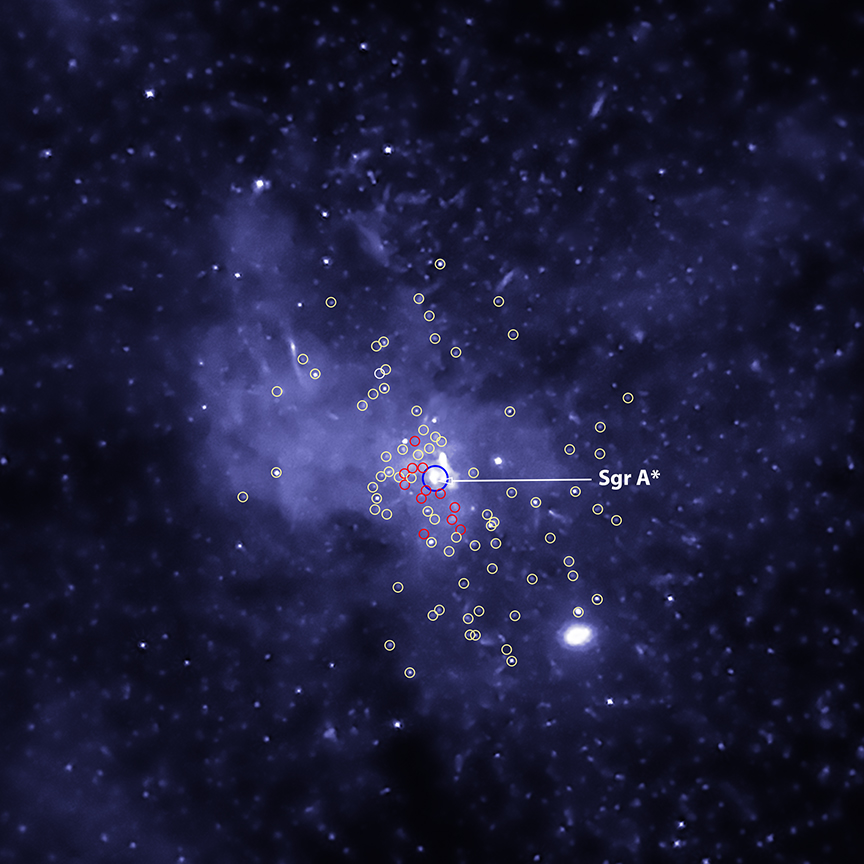
A Plurality of Singularities at the Galactic Center
Image Credit: +NASA /CXC / Columbia Univ./ C. Hailey et al.
https://apod.nasa.gov/apod/ap180512.htmlA recent informal poll found that astronomers don’t yet have a good collective noun for a group of black holes, but they need one. The red circles in this Chandra Observatory X-ray image identify a group of a dozen black holes that are members of binary star systems. With 5 to 30 times the mass of the Sun, the black hole binaries are swarming within about 3 light-years of the center of our galaxy where the supermassive black hole identified as Sagittarius A* (Sgr A*) resides. Yellow circles indicate X-ray sources that are likely less massive neutron stars or white dwarf stars in binary star systems. Alone, black holes would be invisible, but as part of a binary star system they accrete material from their normal companion star and generate X-rays. At the distance of the galactic center Chandra can detect only the brighter of these black hole binary systems as point-like sources of X-rays, hinting that many fainter X-ray emitting black hole binaries should exist there, as yet undetected.
Importé de Google+
Google+ reshared post
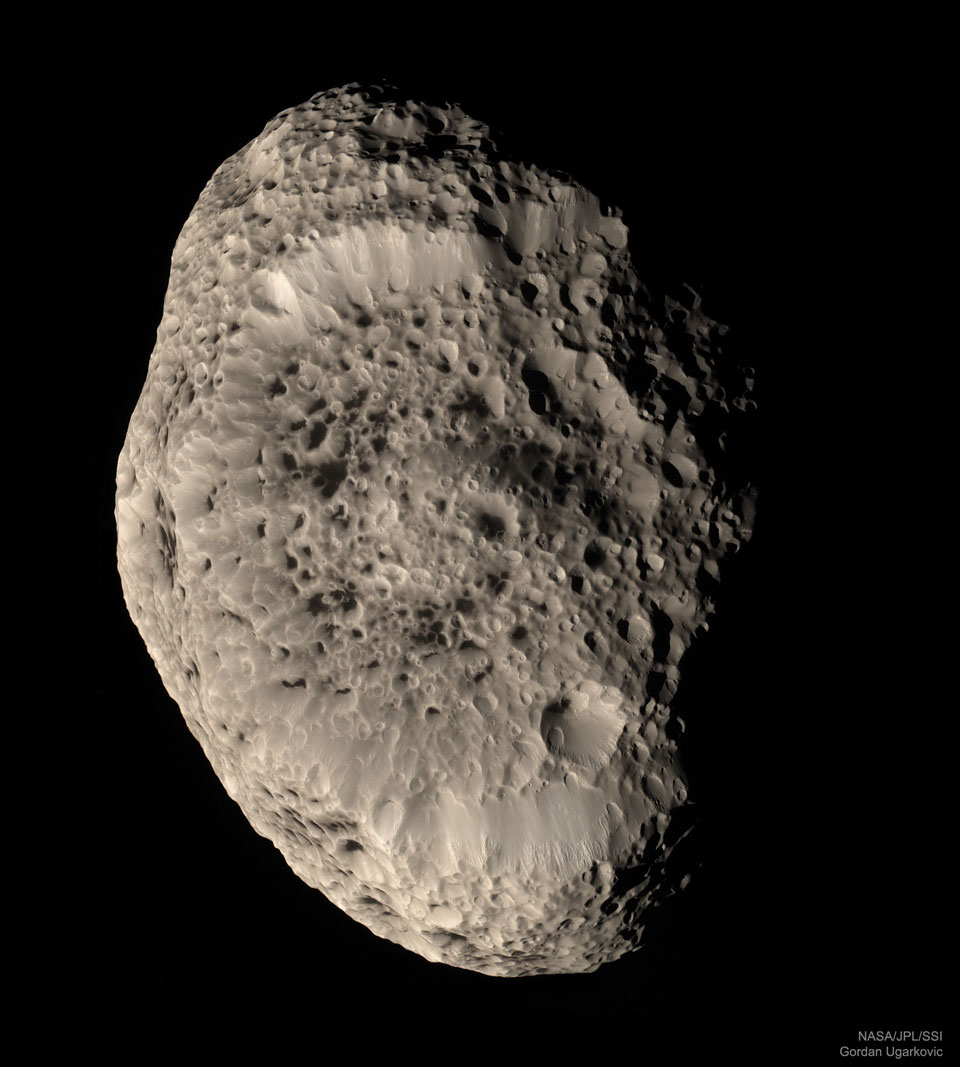
Saturn’s Hyperion in Natural Color
Image Credit & License: +NASA / +NASA Jet Propulsion Laboratory /SSI; Composition: Gordan Ugarkovic
https://apod.nasa.gov/apod/ap180514.htmlWhat lies at the bottom of Hyperion’s strange craters? To help find out, the robot Cassini spacecraft now orbiting Saturn swooped past the sponge-textured moon in 2005 and 2010 and took images of unprecedented detail. A six-image mosaic from the 2005 pass, featured here in natural color, shows a remarkable world strewn with strange craters and an odd sponge-like surface. At the bottom of most craters lies some type of unknown dark reddish material. This material appears similar to that covering part of another of Saturn’s moons, Iapetus, and might sink into the ice moon as it better absorbs warming sunlight. Hyperion is about 250 kilometers across, rotates chaotically, and has a density so low that it likely houses a vast system of caverns inside.
Importé de Google+
Importé de Google+
Google+ reshared post
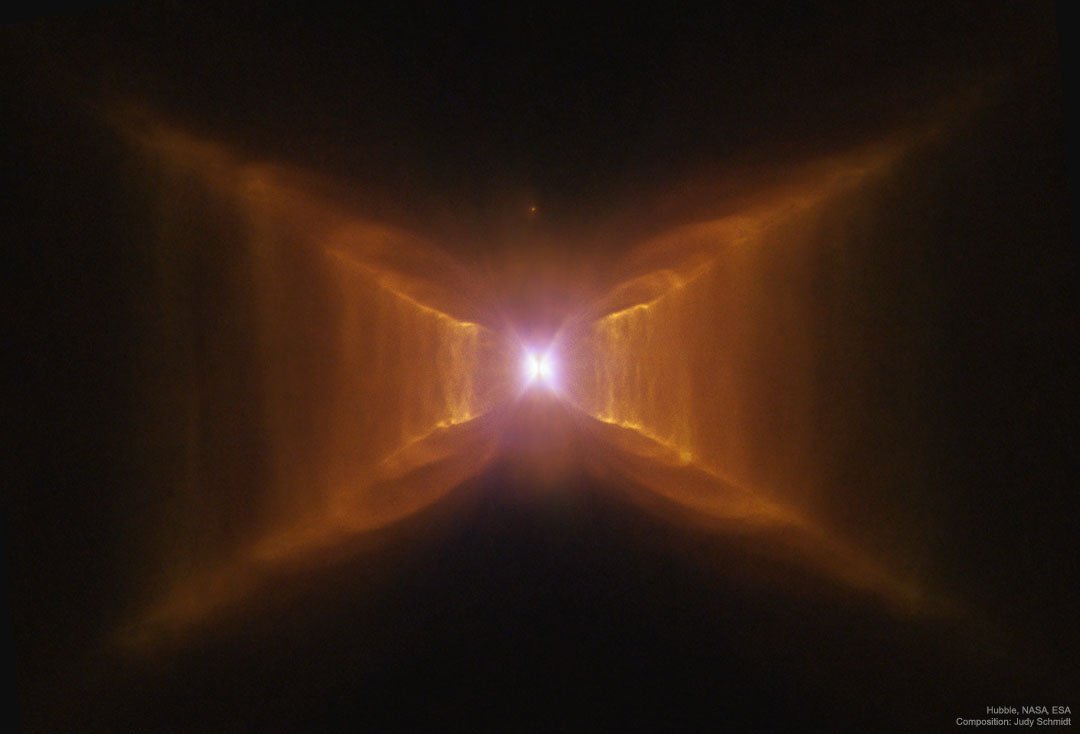
The Red Rectangle Nebula from Hubble
Image Credit: Hubble, +NASA, +European Space Agency, ESA; Processing & License: Judy Schmidt
https://apod.nasa.gov/apod/ap180509.htmlHow was the unusual Red Rectangle nebula created? At the nebula’s center is an aging binary star system that surely powers the nebula but does not, as yet, explain its colors. The unusual shape of the Red Rectangle is likely due to a thick dust torus which pinches the otherwise spherical outflow into tip-touching cone shapes. Because we view the torus edge-on, the boundary edges of the cone shapes seem to form an X. The distinct rungs suggest the outflow occurs in fits and starts. The unusual colors of the nebula are less well understood, however, and speculation holds that they are partly provided by hydrocarbon molecules that may actually be building blocks for organic life. The Red Rectangle nebula lies about 2,300 light years away towards the constellation of the Unicorn (Monoceros). The nebula is shown here in great detail as recently reprocessed image from Hubble Space Telescope. In a few million years, as one of the central stars becomes further depleted of nuclear fuel, the Red Rectangle nebula will likely bloom into a planetary nebula.
Importé de Google+
Il y a un lien vers un GIF animé dans la description. Spectaculaire!
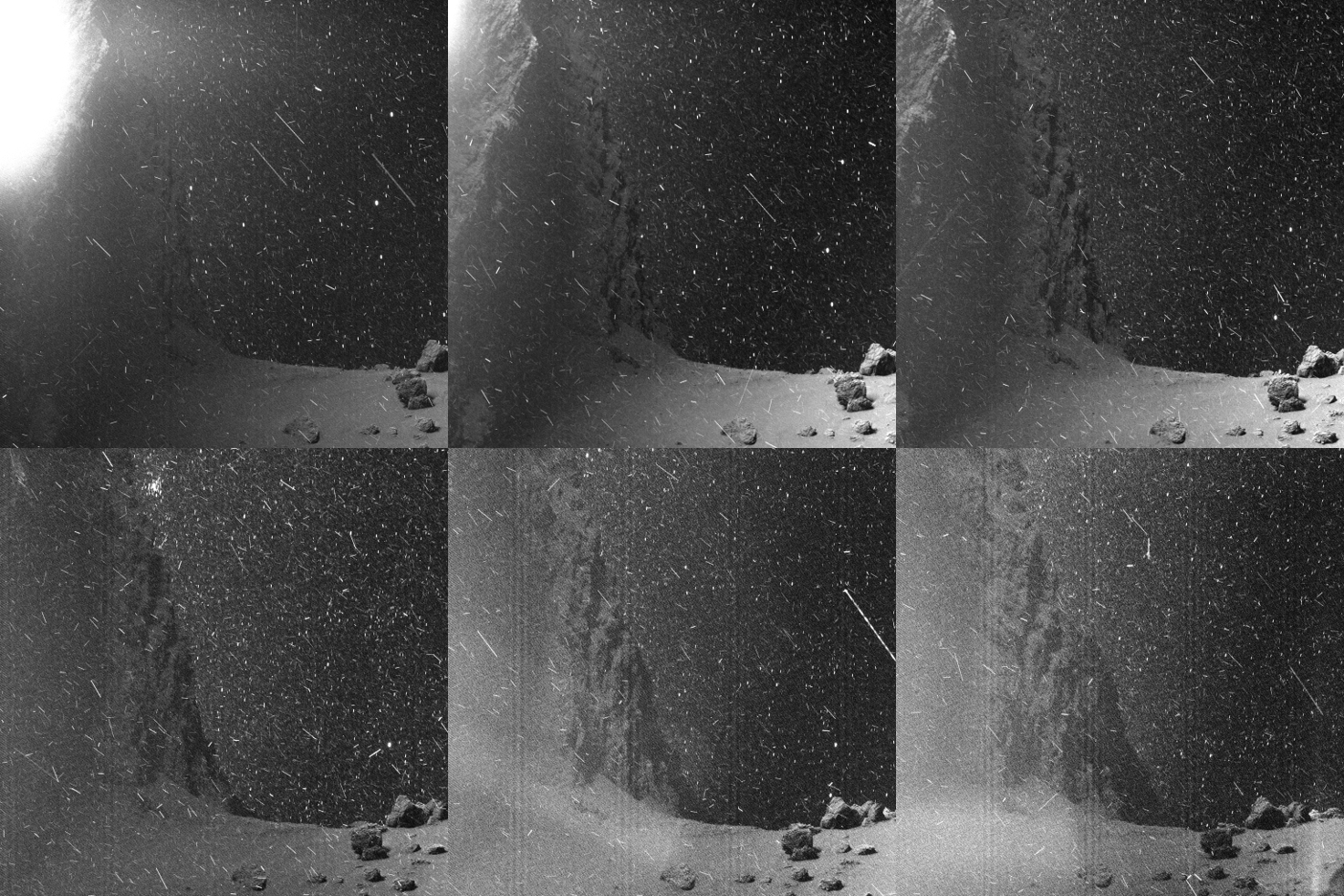
APOD: 2018 April 26 – The Snows of Churyumov Gerasimenko
Importé de Google+