Apollo 11 Saturn V Launch (HD) Camera E-8

Via: dvorak.org: Video – High Quality Apollo 11 Saturn V Launch

Apollo 11 Saturn V Launch (HD) Camera E-8 from Mark Gray on Vimeo.

This clip is raw from Camera E-8 on the launch umbilical tower/mobile launch program of Apollo 11, July 16, 1969. This is an HD transfer from the 16mm original. Even more excellent footage is available on our DVDs at our website at http://www.spacecraftfilms.com

The camera is running at 500 fps, making the total clip of over 8 minutes represent just 30 seconds of actual time. Narration is provided by Mark Gray (me), Executive Producer for Spacecraft Films.

The mystery of the mega-selling floppy disk

bc.co.uk: The mystery of the mega-selling floppy disk

Via: slashdot.org: The Mystery of the Mega-selling Floppy Disk

Sony has said it will stop making floppy disks, after nearly three decades of manufacture. Yet millions of them are still being bought every year. But who is actually buying them?

The vast desks that control the light shows and sounds settings in theatres or music venues have until recently come with floppy drives as standard; the English National Opera is just one example of an organisation that uses them.

A volunteer at the National Museum of Computing says that many scientific instruments – so-called dataloggers, oscilloscopes and the like – record their data onto floppies.

But these relatively niche uses couldn’t possibly account for the number of floppies – something like a million a month – that are being consumed in the UK alone.

The answer may simply be that there are a great many old computers that read only floppies, and a great many computer users that have no need for the storage media that have supplanted them in other quarters.

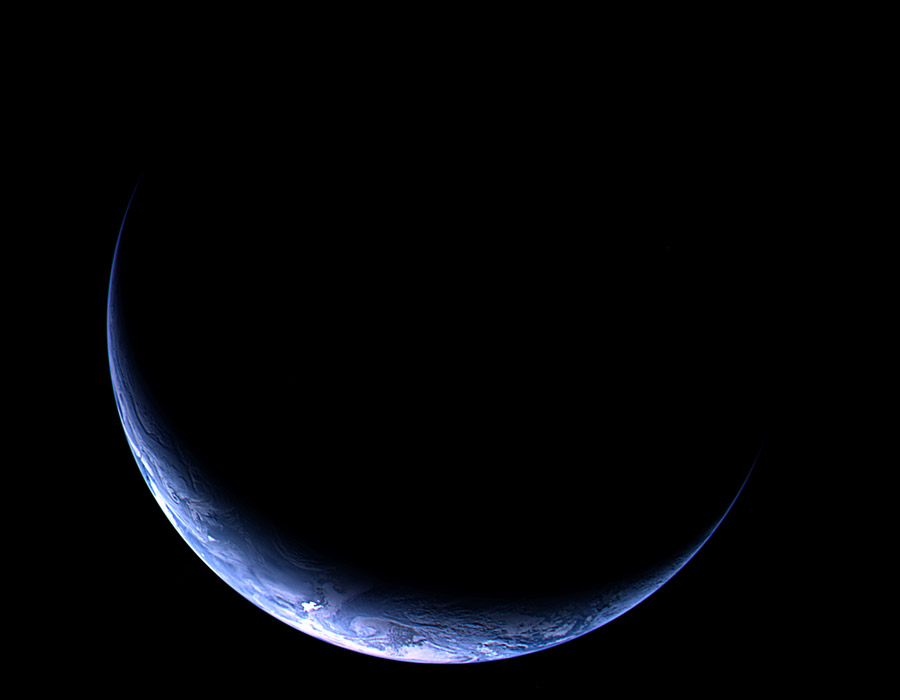
APOD: Crescent Earth from the Departing Rosetta Spacecraft

APOD: Crescent Earth from the Departing Rosetta Spacecraft

Explanation: Goodbye Earth. Earlier this month, ESA’s interplanetary Rosetta spacecraft zoomed past the Earth on its way back across the Solar System. Pictured above, Earth showed a bright crescent phase featuring the South Pole to the passing rocket ship. Launched from Earth in 2004, Rosetta used the gravity of the Earth to help propel it out past Mars and toward a 2014 rendezvous with Comet Churyumov-Gerasimenko. Last year, the robot spacecraft passed asteroid 2867 Steins, and next year it is scheduled to pass enigmatic asteroid 21 Lutetia. If all goes well, Rosetta will release a probe that will land on the 15-km diameter comet in 2014.

Two-Dimensional Pathology: Befunge

scienceblogs.com: Two-Dimensional Pathology: Befunge

In Befunge, there’s a read-head that moves over the program. Each step, it executes the instruction under the head. But instead of just moving left or right, it can move left, right, up, or down. “>” is an instruction that tells the head to start moving to the right; “<" tells the head to start moving left; "^" means start moving up, and "v" means to start moving down. So, for example: >v
^<

Is a program that runs an infinite loop: the head will just cycle over those four characters. An even more interesting infinite loop (taken from the befunge documentation) is:

C’est rien, compare a l’autre exemple de code que vous retrouverai sur le site via le lien plus haut. Outch! 🙂

Goldman’s Fabrice Tourre: Much more than a faceless math whiz

theglobeandmail.com: Goldman’s Fabrice Tourre: Much more than a faceless math whiz

Fabrice Tourre has led a life most mathematicians can only dream about – ski trips to fancy resorts, a $2-million annual salary and at least a couple of girlfriends in exotic European cities.

In one e-mail sent to a girlfriend in January, 2007, he lamented that he had to “mentor others, in view of the fact that I am now considered a ‘dinosaur’ … I feel like I’m losing my mind and I’m only 28!!! OK, I’ve decided two more years of work and I’m retiring.”

Liberte 30! C’est mieux que mon but de liberte 35! Ca sera peut-etre Prison 30 😉

Epsilon Aurigae

Via: Cosmic Variance: My Favorite Star

In that case, we could imagine that the central star (presumably holding the disk together) could clear out a region near the center, and light passing through that hole could account for the brightening. I wrote a simple computer program (QuickBASIC on an IBM PC!) to calculate the light curve in this model, and we were able to get an extremely good fit to the data.

But technology has advanced quite a bit since my student years. Nowadays, we don’t need to puzzle out the meaning of a light curve and come up with an elaborate story involving tilted disks; we can just take pictures of the thing.