Via: Cosmic Variance: A Cornucopia of Time Talks
Je vais probablement ecouter les autres conferences suggerees par Sean Carroll, mais pour l’instant je n’ai ecoute que la premiere qui est vraiment interessante.
Via: Cosmic Variance: A Cornucopia of Time Talks
Je vais probablement ecouter les autres conferences suggerees par Sean Carroll, mais pour l’instant je n’ai ecoute que la premiere qui est vraiment interessante.
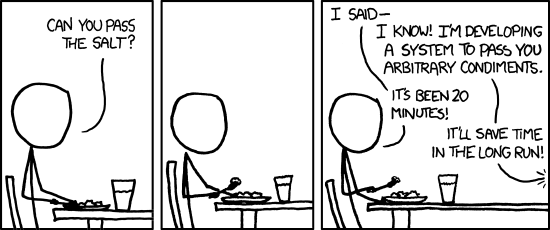
I find that when someone’s taking time to do something right in the present, they’re a perfectionist with no ability to prioritize, whereas when someone took time to do something right in the past, they’re a master artisan of great foresight.
Kali & the Kaleidoscope: KNK103: The Crystals of Mt. Zeta
Via: slashdot.org: Indian Mathematician Takes Shot At Proving Riemann Hypothesis
The protagonist of this expedition is a creature called the Zeta function which, under certain conditions, squeezes the prime numbers scattered over an imaginary rubber sheet into a straight line. In highly technical language, the hypothesis is very brief: “The non-trivial zeroes of the Riemann-zeta function have real part equal to 1/2” which may take a couple of months for a non-mathematician to fully grasp. This is why during the online workshop we will start with the very basics – what is a prime number?
Start with the basic…. On est loin du but….<sarcasme> bonne chance! </sarcasme>
J’aime bien l’idee d’un workshop en ligne et d’exposer le probleme au plus de monde possible. Malheureusement, c’est plus une facon de faire de l’argent (il faut payer pour participer et/ou suivre l’atelier) qu’un exercice dans le but de resoudre le probleme.
Via: Belief in God Boils Down to a Gut Feeling
Ce que j’aime particulierement, c’est la question posee:
Shenhav and his colleagues investigated that question in a series of studies. In the first, 882 American adults answered online surveys about their belief in God. Next, the participants took a three-question math test with questions such as, “A bat and a ball cost $1.10 in total. The bat costs $1 more than the ball. How much does the ball cost?”
The intuitive answer to that question is 10 cents, since most people’s first impulse is to knock $1 off the total. But people who use “reflective” reasoning to question their first impulse are more likely to get the correct answer: 5 cents.
Donc, si je comprends bien, repondre 10 cents est “intuitif” et le monde “intuitif” tend a croire a des conneries? ROTFLMAO.
Deux excellents petits articles sur la gestion de code. Les commentaires sont aussi interessants a lire.
Good Math, Bad Math: Things Everyone Should Do: Code Review
Good Math, Bad Math: Stuff Everyone Should Do (part 2): Coding Standards
