Importé de Google+
Wheeler Jump
Reply
Importé de Google+
Importé de Google+
De la description sur youtube:
"Visualization and "audibilization" of 15 Sorting Algorithms in 6 Minutes.
Sorts random shuffles of integers, with both speed and the number of items adapted to each algorithm’s complexity.
The algorithms are: selection sort, insertion sort, quick sort, merge sort, heap sort, radix sort (LSD), radix sort (MSD), std::sort (intro sort), std::stable_sort (adaptive merge sort), shell sort, bubble sort, cocktail shaker sort, gnome sort, bitonic sort and bogo sort (30 seconds of it)."
Google+ reshared post
NERD ALERT
Get your nerd on!
This is awesome! Fun to watch even if you don’t know wtf is going on.
Importé de Google+
slashdot.org: Lower Limit Found For Sudoku Puzzle Clues
An Irish mathematician has used a complex algorithm and millions of hours of supercomputing time to solve an important open problem in the mathematics of Sudoku, the game popularized in Japan that involves filling in a 9X9 grid of squares with the numbers 1–9 according to certain rules.
Gary McGuire of University College Dublin shows in a proof posted online on 1 January1 that the minimum number of clues — or starting digits — needed to complete a puzzle is 17; puzzles with 16 or fewer clues do not have a unique solution. Most newspaper puzzles have around 25 clues, with the difficulty of the puzzle decreasing as more clues are given.
“The approach is reasonable and it’s plausible. I’d say the attitude is one of cautious optimism,” says Jason Rosenhouse, a mathematician at James Madison University in Harrisonburg, Virginia, and the co-author of a newly released book on the maths of Sudoku.
Having spent two years testing the algorithm, McGuire and his team used about 700 million CPU hours at the Irish Centre for High-End Computing in Dublin, searching through possible grids with the hitting-set algorithm. “The only realistic way to do it was the brute force approach,” says Gordon Royle, a mathematician at the University of Western Australian in Perth who had been working on the problem of counting 17 clue puzzles using different algorithms.
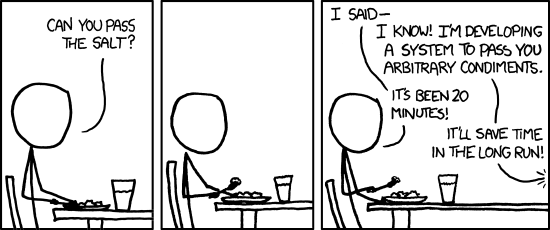
I find that when someone’s taking time to do something right in the present, they’re a perfectionist with no ability to prioritize, whereas when someone took time to do something right in the past, they’re a master artisan of great foresight.
Deux excellents petits articles sur la gestion de code. Les commentaires sont aussi interessants a lire.
Good Math, Bad Math: Things Everyone Should Do: Code Review
Good Math, Bad Math: Stuff Everyone Should Do (part 2): Coding Standards
Via: Cosmic Variance: DNA Takes Square Roots
Caltech researchers Lulu Qian and Erik Winfree have managed to coax 130 strands of DNA into performing what is unquestionably a calculation: taking the square root of a number. (Ars Technica post; Science paper behind paywall; open-access background paper.) Not a big number: we’re talking about four-digit binary numbers, so 15 at the biggest. And not very efficiently: with prodding, the calculation took eight hours. Moore’s Law isn’t really in danger here.