Importé de Google+
Jason Paul’s Freerunning Illusions
Reply
Importé de Google+
Importé de Google+
Importé de Google+
Google+ reshared post
Saturn’s ring system is far, far bigger than previously thought:
http://www.cbsnews.com/news/saturns-ring-found-to-be-biggest-in-solar-system/Image via https://www.facebook.com/beyondoursight?fref=photo
Importé de Google+
Google+ reshared post
How to make a black hole
+Brian Koberlein, one of the most consistently energetic and interesting people here on G+, recently wrote about how to make a black hole.
His recipe works like this:
INGREDIENTS: one small neutron star, one solar mass of hydrogen.
Take a neutron star 2 weighing solar masses. Gradually add one solar mass of hydrogen gas, letting it fall to the surface of the neutron star. Be careful: if you add too much too quickly, you’ll create a huge nuclear explosion called a nova. When your neutron star reaches 3 solar masses, it will collapse into a black hole.
This is the smallest type of black hole we see in nature. The problem with this recipe is that we’d need to become at least a Kardashev Type II civilization, able to harness the power of an entire star, before we could carry it out.
Louis Crane, a mathematician at the University of Kansas, has studied other ways to make a black hole. It’s slightly easier to make a smaller black hole – and perhaps more useful, since the Hawking radiation from a small black hole could be a good source of power.
Crane is interested in powering starships, but we could also use this power for anything else. It’s the ultimate renewable energy source: you drop matter into your black hole, and it gets turned into electromagnetic radiation!
Unfortunately, even smaller black holes are tough to make. Say you want to make a black hole whose mass equals that of the Earth. Then you need to crush the Earth down to the size of a marble. The final stage of this crushing process would probably take care of itself: gravity would do the job! But crushing a planet to half its original size is not easy. I have no idea how to do it.
Luckily, to make power with Hawking radiation, it’s best to make a much smaller black hole. The smaller a black hole is, the more Hawking radiation it emits. Louis Crane recommends making a black hole whose mass is a million tonnes. This would put out 60,000 terawatts of Hawking radiation. Right now human civilization uses only 20 terawatts of power. So this is a healthy power source.
You have to be careful: the radiation emitted by such a black hole is incredibly intense. And you have to keep feeding it. You see, the smaller a black hole is, the more Hawking radiation it emits – and as it emits radiation, it shrinks! Eventually it explodes in a blaze of glory: in the final second, it’s about 1/100 as bright as the Sun. To keep your black hole from exploding, you need to keep feeding it. But for a black hole a million tons in mass, you don’t need to rush: it will last about a century before it explodes if you don’t feed it.
Unfortunately, to make a black hole that weighs a million tonnes, you need to put a million tonnes of mass in a region 1/1000 times the diameter of a proton.
This is about the wavelength of a gamma ray. So, if we could make gamma ray lasers, and focus them well enough, we could in theory put enough energy in a small enough region to create a million-ton black hole. He says:
Since a nuclear laser can convert on the order of 1/1000 of its rest mass to radiation, we would need a lasing mass of about a gigatonne to produce the pulse. This should correspond to a mass of order 10 gigatonnes for the whole structure (the size of a small asteroid). Such a structure would be assembled in space near the sun by an army of robots and built out of space-based materials. It is not larger than some structures human beings have already built. The precision required to focus the collapsing electromagnetic wave would be of an order already possible using interferometric methods, but on a truly massive scale. This is clearly extremely ambitious, but we do not see it as impossible.
I’m not holding my breath, but with luck our civilization will last long enough, and do well enough, to try this someday.
For details, see:
• Louis Crane and Shawn Westmoreland, Are black hole starships possible, http://arxiv.org/abs/0908.1803.
Here is Brian’s post on how to build a black hole:
https://plus.google.com/u/0/+BrianKoberlein/posts/epaoFG9hsh4
#spnetwork arXiv:0908.1803 #blackhole

Importé de Google+
Google+ reshared post
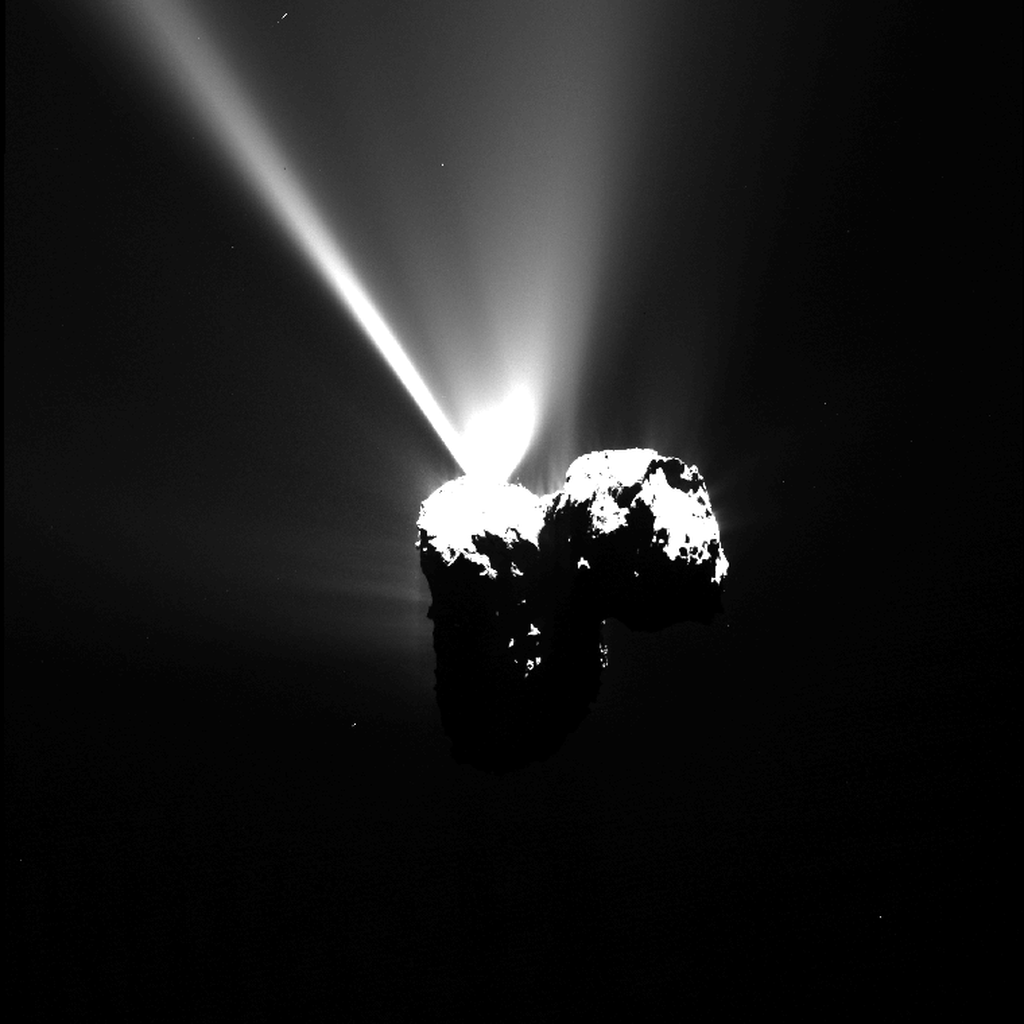
Perihelion Approaches
Image Credit: +European Space Agency, ESA / Rosetta / MPS for OSIRIS Team; MPS/UPD/LAM/IAA/SSO/INTA/UPM/DASP/IDA
http://apod.nasa.gov/apod/ap150815.htmlThis dramatic outburst from the nucleus of Comet 67P/Churyumov-Gerasimenko occured on August 12, just hours before perihelion, its closest approach to the Sun. Completing an orbit of the Sun once every 6.45 years, perihelion distance for this periodic comet is about 1.3 astronomical units (AU), still outside the orbit of planet Earth (at 1 AU). The stark image of the 4 kilometer wide, double-lobed nucleus in bright sunlight and dark shadows was taken by the Rosetta spacecraft’s science camera about 325 kilometers away. Too close to see the comet’s growing tail, Rosetta maintains its ringside seat to watch the nucleus warm and become more active in coming weeks, as primordial ices sublimating from the surface produce jets of gas and dust. Of course, dust from the nucleus of periodic comet Swift-Tuttle, whose last perihelion passage was in 1992 at a distance of 0.96 AU, fell to Earth just this week.
Importé de Google+
Importé de Google+
"Many years passed and work and life took me far from home, having me relocating in Asia (Shanghai) several years ago, where I currently live with my family. The incredible light pollution of this city and consequent impossibility to take astronomical photography, forced me to relocate all my equipment under the dark skies of the Australian outback, where I built a small observatory I control remotely through the Internet from everywhere I am."
Wow! Parlez moi de quelqu’un qui s’organise pour faire ce qu’il aime….. un italien qui a un observatoire en Australie et qui le controle a partir de Shanghai!!!! Et regardez les resultats dans ses galleries sur son site. Fantastique!

Importé de Google+

